A description of 20 Totts Lane as it was circa 1974
Members of the Parker family had lived in Totts Lane from the 1880s both in No 20 and the house next door.
Totts Lane in the 1950s, taken from the allotment gate looking toward No 14, with Roger Dunz (grandson of the Parkers)
At the front of the house there was a wall I don’t remember any gate. There was a pathway across the narrow front garden of the house and up to the front door made of bricks and stone loosely laid on the ground. The path round to the back of the house was gravel and cinders. A fairly deep ditch separated the property from a field on which are now the allotments.
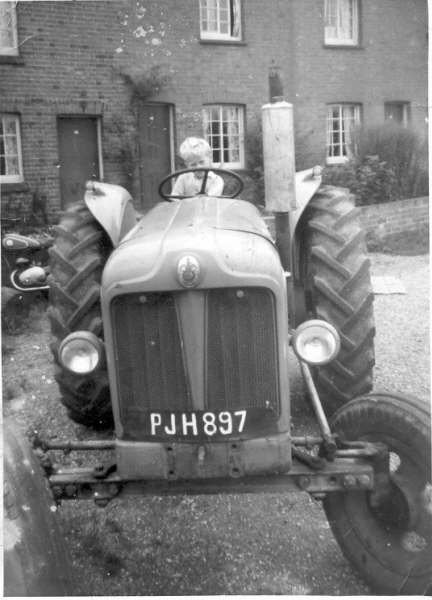
with Roger Dunz (grandson of the parkers)
Going through the front door, on the left hand side of the front room were wooden boards lining the wall for about half the height of the room. On the right hand side were two alcoves one each side of a central range. The range was taken out in the mid-sixties and a completely new open fire was built in its place.
At the bottom of each alcove was a cupboard of slightly less than half the height of the room, with two opening doors. Between the right hand side of the range and the cupboard was a 15 amp round pin electrical socket; the only one in the house except for one on the cooker control box. A paraffin lamp always stood on the top of the left hand cupboard and had survived from the days before the house was connected to mains electricity. A table and chairs were placed in the centre of the room and a sofa stood under the front window. The floor was covered in lino, and rugs made by Mrs Cox who lived at the other end of the block, were scattered round. The hearth was made of stone and was always kept white. This had been done by getting chalk from a pit near the Bennington/Aston junction on the Watton road, long since filled in. This was mixed with water and rubbed onto the hearth. A single bulb hung from the centre of the ceiling without a shade.
From this room a door lead into the kitchen with a single step down. This was very worn in the centre and probably made of stone. The floor was made of brick or stone, again with homemade rugs scattered round. To the left was a walk-in cupboard under the stairs and then another door which lead to the staircase. At right angles to this door was the back door leading to the garden. Next was a large white porcelain kitchen sink supported on two brick piers with only a cold water tap. There was no provision for running hot water at all. An electric cooker, small table and small cupboard completed the kitchen.
Going through the door to the staircase, the stairs made a sharp left turn then up to a very small landing. The door to the room on the left almost opening onto the stairs themselves. The door to the other room being in line with the stairs. The dividing wall between the two rooms was made of tongue and grooved wood. The ceilings were made of lath and plaster and on more than one occasion large pieces fell down when broken slates allowed water in.
Returning downstairs again and out of the backdoor. Slightly to the right and across the yard was a wash house which contained a large bowl suspended by brickwork over a hearth. This was used on wash days to boil the clothes. There was also a large mangle with exposed gearing.
Fairly close to the back door of the adjacent house was a well. I remember it having a wooden cover at one time and my mother dropping a stone down the well through a crack. It had water in it at that time. I believe a concrete cover was put over it later on, but the well itself was probably not filled in.
Immediately outside the back door and joined to the outside wall my grandfather had built a wooden shed for his motorcycle. Later on this was demolished and a flushed toilet was built here in a small brick extension. I don’t think the house ever had a proper bathroom.
Moving further round the back path, at the nearest point that the property came to the ditch, there was the original brick-built toilet. Connected to the side of it were brick coal sheds which joined the house by the front door. The one nearest the house was my grandparents, I think the other one was for the next door neighbour.
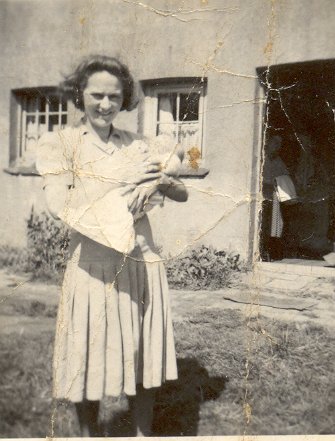
Eileen Dunz nee Parker with baby,
Mrs Parker in doorway
The garden was used mainly for keeping chickens for eggs, and cockerels for Christmas. An allotment was also worked on ground which the large house opposite [White Hills] now occupies, although this was already built by 1974. Pigs were also kept on the allotment in earlier times.
I am told that an Anderson shelter was built in the back garden in the War years, but had been cleared before my time.
Brian Albon, November 2012
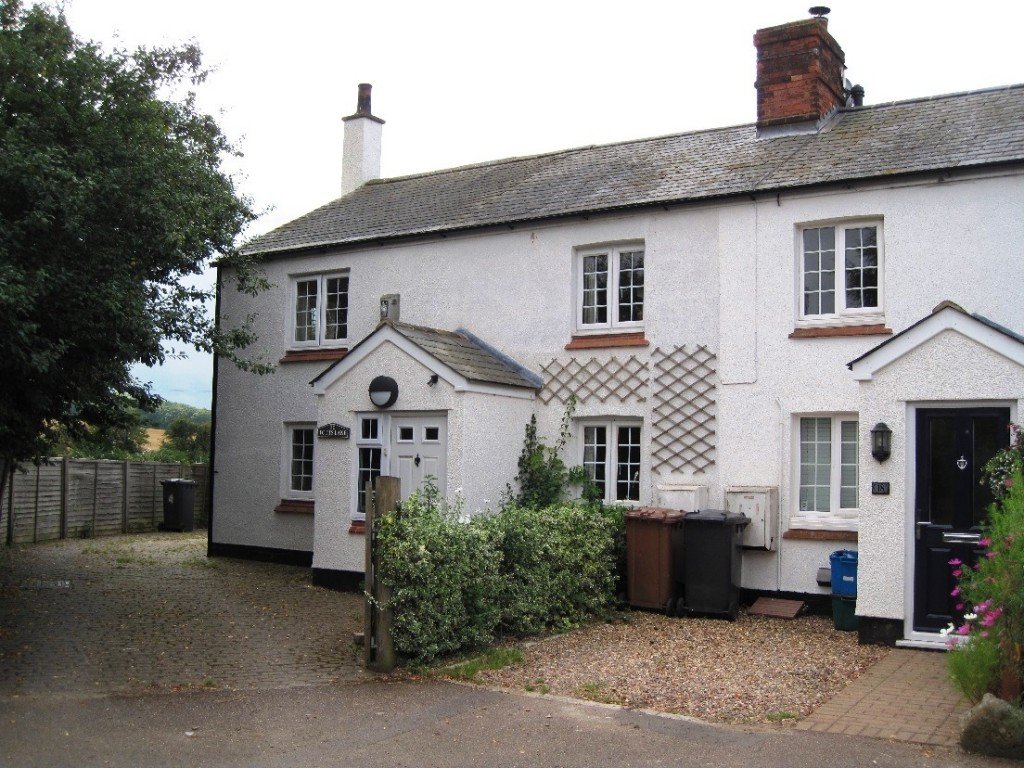
The porches are new