Reproduced from ‘A History Tour of Walkern’ by Janet Woodall published in 2014
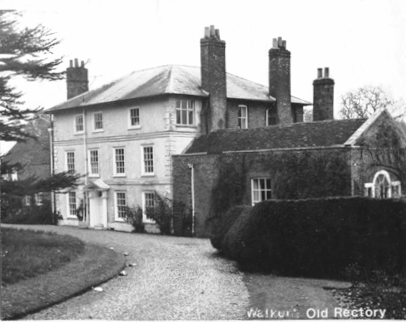
John Gorsuch was born in 1600 (the same year as Charles I) to Daniel Gorsuch, a mercer of London. When John was 31, his father bought the advowson1 of Walkern and appointed John as rector. Daniel had already invested in property in Walkern and he now built a new rectory, an early brick-built house, for his son. In a Glebe Terrier2 dated 1638 the new building was described as having “below, one parlour, a hall, a kitchen, a milk house, a brew house, a store house, two cellars; above, in the first and second storeys, nine chambers well boarded”
As a ‘High Church’ man who sided with the King, John Gorsuch inevitably became embroiled in the English Civil War. In 1637 Thomas Humberstone of Walkern Park and his wife Ann, both refused to come to the altar rails for Holy Communion but knelt in the chancel, an action associated with Puritanism. The rector, being a follower of Archbishop William Laud3, refused to serve them. This religious and political argument culminated in Gorsuch being removed as rector in 1642 by an Act of Parliament. But Gorsuch refused to leave Walkern and made a nuisance of himself to his Parlimentarian successors, until one of whom, Revd Simon Smeath, in 1648, sent men to ‘eject’ him. Gorsuch fled the village and died in Cambridgeshire, mysteriously “smothered in a haymow“. When Charles II was restored to the throne in 1662, Revd Smeath was removed from office.
1 The right to appoint a rector
2 A Glebe Terrier is a survey and inventory of church property
3 William Laud was Charles I’s Archbishop of Canterbury who opposed religious toleration and who introduced altar rails into church to remove common rable from the sacred altar. Parliament later decreed that altar rails were to be removed.
You may also be interested in
John Gorsuch : our ‘scandalous malignant priest‘
1642 – 1649 : Walkern in the Civil War