Reproduced from A History Tour of Walkern written by Janet Woodall in 2014
The first reference to Jane Wenham in Walkern is in 1679 as wife of Philip Cook when their daughter Elizabeth was baptised at St Mary’s. Another daughter, Sarah, was baptised at St Mary’s two years later. Philip Cooke died in November 1696 and by February 1697 Jane had married Edward Wenham, the 24 year old son of Henry and Mary Wenham of Walkern. It is possible that this caused the resentment, and it was later stated that rumours about Jane Wenham being a witch date from around this time. Edward Wenham appears to have sought ‘divorce’ from Jane Wenham within a few years of their marriage. In 1712, Jane, by now a poor, starving elderly woman, was accused by farmer John Chapman of bewitching his farmhand when he refused to give her a handful of straw, to sell to strawplaiters or to use herself. He had long suspected her of bewitching livestock. Then Anne Thorn, maid to Walkern’s Rector, Revd Godfrey Gardiner, started behaving strangely, and Jane was arrested.
After suffering more accusations and witch finding ordeals at the hands of the Rector and other villagers, Jane was sent to trial at Hertford, charged with ‘Conversing with the Devil in the shape of the cat’. The jury found her guilty and she was sentenced to death, but was reprieved and given a Royal Pardon from Queen Anne. She lived the rest of her long life at Gilston Park and then Hertingfordbury, where she died in 1730.
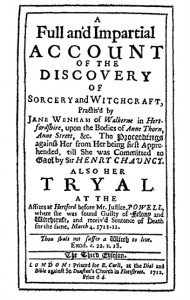
on the Jane Wenham trial
The events surrounding Jane Wenham caused a sensation, with pamphlets being printed for years afterwards either insisting that she was a witch, or ridiculing witchcraft proclaiming her innocent. The pamphlet ‘A Full and Impartial Account of the Discovery of Sorcery and Witchcraft Practis’d by Jane Wenham of Walkern’ was one of three tracts written by Revd Francis Bragge, one of her chief accusers, in favour of Jane Wenham’s conviction. This pamphlet is especially interesting as it contains detail of the many villagers involved in events leading up to her trial
The Jane Wenham debate was instrumental in changing attitudes so that by 1718 it was no longer respectable to believe in witchcraft.
You may also be interested in :
Witchcraft Debate in the early 18th Century
Witch hunt for lost portrait