From Walkern Journal March 2007
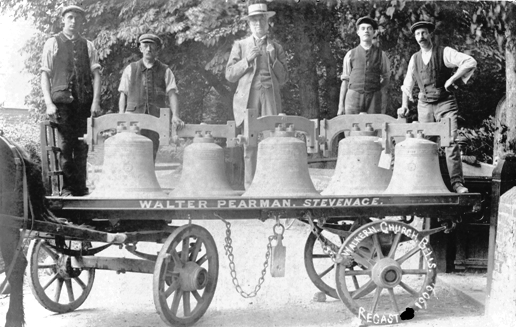
At St Mary’s Church in Walkern we have six bells: The bell highest in pitch is known as the treble and the bell lowest in pitch is called the tenor. For convenience, the bells are numbered, with the treble being number 1 and the other bells numbered by their pitch — 2,3,4, etc. — sequentially down the scale.
1. Treble, note F. Cast in 1926 by Taylors of Loughborough. This is decorated with a bell and pomegranate band, and with the inscription “erected to the glory of God”. It weighs 3cwt 2qtr 7lb (181 kg).
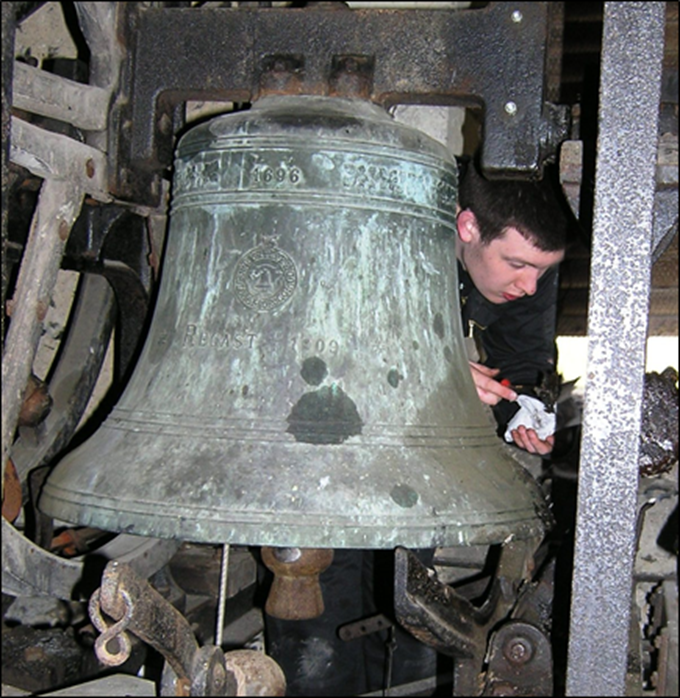
2. Note E flat. Originally cast in 1696 but recast in 1909 by Taylors and decorated with the Taylor wine pattern. Weight 4cwt 1qtr 12lbs (221 kg).
3. Note D flat, cast in 1833 by Thomas Mears of London (now the Whitechapel Bell Foundry). Weight 3cwt 3qtr 1lb (190 kg).
4. Note C. Originally cast in 1713, recast in 1909 by Taylors and decorated with the Taylor wine pattern. Weight 4cwt 2qtr 22lb (238 kg).
5. Note B flat. Originally cast in 1713, recast in 1909 by Taylors, and carries the inscription “Godfrey Gardener Rector Walkon 1713”. Weight 5cwt 2qtr 17lb (287 kg).
6. Tenor, note A flat. Cast in 1713 and carrying the inscription “Edward Green Church Warden 1713”. Weight 6cwt 2qtr 16lbs (337 kg)
The average tenor bell weighs 10 cwt or 508 Kg (about the weight of a very small car) so these bells are classed as light!
Bell-ringing goes back hundreds of years. In York Minster there is an early 14th century stained glass window showing a bell being cast. The same techniques are used today. Bells are an alloy of approximately 77% copper and 23% tin. Too much copper and the bell will be too brittle, too much tin and the sound will be dreadful! It is customary to tune each bell with a number of notes. Most people will only be aware of the “strike note” and the “hum note”.
A bell will sound flat when it is cast. Metal is shaved off specific parts inside the bell to achieve the right notes. If too much is taken off, the bell will be useless and will have to be recast.
The ropes were originally made from hemp, but the ones at St Mary’s are made from flax. Being a natural material, the rope will take up a considerable amount of water from the atmosphere, up to 30% of the rope’s weight, so affecting the length and weight of the rope. The coloured, fluffy part of the rope is made from wool, woven into the flax and is called the “sally”.
Each bell is suspended from a headstock, which in turn is connected to the bellframe by bearings, allowing the bell to rotate through just over 360 degrees; the headstock is fitted with a wooden wheel around which the rope is wrapped. Before a bell can be rung, it has to be put up into its ringing position. In effect the bell is turned upside down and balanced on its narrowest point! The rope is then tied in such a way as to show other ringers that the “bell is up”. After ringing, the reverse has to be done and the bell is rung down to its resting position. A slightly different knot is tied showing that the bell is down. On some practice nights, the bells are rung down in peel, i.e. all at the same time.
During the swing, the clapper inside the bell strikes making the bell resonate once. This action constitutes the handstroke, at the end of which the ringer’s arms are above his head and a portion of the bell-rope is wrapped around almost the entirety of the wheel. After a pause, the ringer again pulls the rope and the bell revolves in the opposite direction, returning to its original position, again sounding once. This is the backstroke.
Bells last for a very long time. In fact it is thought that a bell can be used for 1000 years. After that amount of time, the clapper has worn so much of the bell metal away as it has been rung, that it will be out of tune. The clapper was originally made from wrought iron, newer ones are made from spheroidal graphite iron.
At certain times, i.e. Good Friday, New Year’s Eve, or at a funeral, the clapper will be “muffled”, with a leather muffle being fitted to the clapper to make the back stroke sound more of a rumble. Our muffles were made by the saddle-maker at Sandon, and are fitted by one of the ringers prior to ringing.
From time to time some maintenance work needs to be carried out; the plain bearings oiled, the clappers checked, ropes checked for wear, and a general check that everything is in order. Recently one of the ringers, with his son, carried out some of this routine maintenance.
On a Sunday we usually ring “rounds”, where the bells are rung in order of lightest to heaviest, or “call changes” when the 5 lighter bells are moved in a certain order by the caller, or “kaleidoscope” when certain bells swap for a certain number of times before returning to their original order. We may also ring “Plain Bob” when the 5 lighter bells change places in a set way. There are many different methods, “Grandsire Doubles”, “Stedman Doubles”, “Kent Treble Bob Minor”, etc. On the left is a table showing part of a method called “Plain Bob Doubles”, with number 1 indicating the Treble and 6 the Tenor. We ring this at practice evenings on Fridays and sometimes on a Sunday.
Members from other bands of ringers have been joining us on our practice night to teach us and help us move on as a band. One of our aims is to ring a quarter peal for John Soanes. John, who was our Captain of Bells for many years, will always be greatly missed, and we thought it would be right to ring a quarter peal for him – although it may take us a while to reach that standard.