Norman Henry Tucker (born 17th December 1914) took part in the Walkern Memories: 935 Years project and exhibition, having his memories of Walkern recorded by Janet Woodall and his photo taken by local photographer Rod Shone, on 6 November 2006 [with additional material by Norman Tucker, 2008]. This transcription first appeared in the July/August 2008 issue of the Walkern Journal. Norman passed away just short of his 98th birthday on 14th November 2012.
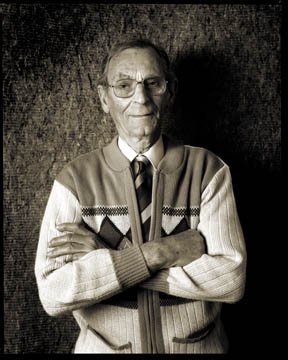
Photo by Rod Shone
“I don’t know if I qualify for this as I am not a local, but I have to admit I have been here quite a long while now. It was in 1940 when my mother was visiting my brother (who had bought Chancy Hall the previous year) that our house in London was bombed in an air raid. My father, who’d been on Home Guard duty that night, came to Walkern and rented the top floor, and subsequentely the whole, of the Laurels.
I came to Walkern after the war in 1945, during which time I drove an ambulance for the London Civil Defence, to join my brother in what turned out to be an ill fated venture into market gardening.
Our main crop at that time was chicory which required quite a bit of intensive work because it was grown in trenches with a fire at each end. We used to go to Cannings wood yard with a horse and cart to get sawdust to keep the fires going for 24 hours a day. Fortunately we managed to find a wholesaler in Covent Garden by the name of Tucker, so we had boxes suitably inscribed to leave about the village at various advantage points, making it look like we were much bigger than we were – quite an advert if you didn’t know the difference!
We also kept about 200 rabbits. Food was rationed, as were clothes and household goods, but no coupons were needed for game, and our rabbits were sold at Hitchin Cattle Market on a Tuesday.
A friend of my father told me you needed sufficient capital to see you over three bad years, and we fell short of that! Unfortunately, owing to a trade agreement between the UK and the Belgian government, they started importing chicory during our second year of effort, and we got about a quarter of the price we had in the first year, and that really was the nail in the coffin as far as we were concerned, and we didn’t progress further than 2 years. Where the old greenhouses are in Froghall Lane, we had that field.
I went to work for the Hertfordshire Agricultural Committee. Half of Box Wood was cleared and used for agriculture during the war. Dig for victory. Everything was ploughed up then, even land that wasn’t really fit for arable land. My job was as a labour officer side of it, finding work for the local Land Army and POWs.
When the Herts Agricultural Committee disbanded, which was when the POWs were repatriated, and the Land army was dissolved, I went to work for an engineering firm and joined their First Aid team as I was quite interested in that having been an ambulance driver for the London Civil Defence during the war. I subsequently joined the St John’s Ambulance Brigade and served in that for about 20 years
When I married in 1948 we started in a cottage in Froghall Lane where the rent was 50p a week and where there was no water or electrics. The stand tap was in the bank opposite, and when I approached the landlord about installing electricity, he agreed to it but only down stairs! He said “you don’t need electrics to go to bed, a candle will do”. The loo was a chemical closet in the barn. I can remember saving up ration coupons to get lino on the bedroom floor – we were really living it up!
When my father died my mother moved to where I was and we moved next door into a pair of cottages converted into one by the local builder Bert Carter and his son Tim. This went with 1/3 acre of garden, and by then we had electricity and sewers installed. Some years later I was able to buy this for £1500 by borrowing £1000 from Mr White the solicitor from Box Wood House.
Recorded 6th November 2006 by Janet Woodall
with additional material by Norman Tucker, 2008