Joyce Lamb (born 1921), Billy Green’s sister, took part in the Walkern Memories: 935 Years project and exhibition, having her memories of Walkern recorded by Janet Woodall and her photo taken by local photographer Rod Shone, on 9 November 2006.
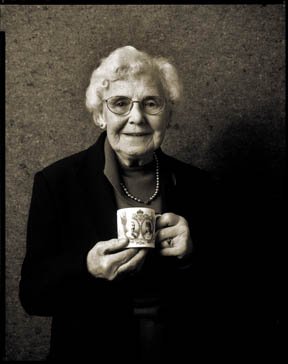
I was born in Ardeley at the Jolly Waggoners, and my mother before me. And five girls (my mother was one of six) who were nearly all schoolteachers. Four of them were school teachers at Ardeley.
My husband was a Yorshireman, from Selby. He worked for the Prudential – he was the first agent for Stevenage Old Town. He sold the first policy, as the New Town expanded, he expanded. He loved Walkern.
Pubs and shops
The Jolly Waggoners was Simpsons of Baldock at that time. They had the Red Lion and also the White Lion in Walkern. They may also have had the Three Horseshoes. I don’t remember the Three Horseshoes as a pub, it was a sweetshop when I was a child. In 1931, Mr Muskett [?] ran it. I think the last person to have the sweetshop was Jan Philips. There was a small hairdressers shop there at one stage, the piece of building that juts out, that was the hairdressing part of it.
Butchers and Bakers
This building [Posy Palace] has always been a butchers. It was Grays, then Shepherds. There was a baker across the road, and almost next door to that Mrs Saunders used to do fish and chips, Mrs Withers house. Then there was Spearman’s the bakers. As you come down the right hand side of the High street from the Dove cote, that was a bakers – though I can’t remember the name, in my father’s time. Of course a lot of people made their own bread then. Then there was Spearmans, then Hanscombes [opposite Posy Palace]. Then in Froghall Lane there was Stockbridge the baker, not that I can remember that, then you went down the High Street to Kitcheners the baker.
Kitcheners and Greens
In between you’d got Kitcheners the grocers shop, and my parents had a greengrocers, they did poultry and all that sort of thing, where Billy lives now, called ‘Lavender House’. My grandparents lived there. Grandfather Green. Grandma came from Luffenhall. We moved down from Ardeley to look after my elderly grandparents. That’s how we came to Walkern. And stayed ever since. When Billy dies there won’t be any more Greens in Walkern.
I worked at Kitcheners grocers shop next to Mum and Dad’s, when war came the man who ran the shop in Benington went to war and I went to that shop. It was a reserved occupation. There was a lot of staff there, they sold everything: working men’s overalls, boots, lamp glasses, all kinds of ‘paraffin things’ On Mondays they killed pigs for pork and made the sausages. I got married in 1942 and worked at Kitcheners until then, and still worked backwards and forwards for them for a while, until Catherine was born in 1946.
Kitcheners went downhill. Money was short so you weren’t selling the stuff, and of course the men had gone to the war. One old Mr Adams had been there all his life, since a boy, with Bernard and Jack’s father, Bernard and Jack Kitchener. They were distant relations of ours you know, my grandmother was a Kitchener.
Jennens Poultry
Where the surgery is now, that was Jennens who apparently came over to Walkern just before the First World War from Stevenage, Pin Green, when the farm was there. They started up a poultry-house business where they specialised in the ‘ark’ for poultry. The ark was like a glorified henhouse, you lifted them with two handles so that you could have your chickens on a bit of spare ground when it was available. They employed a lot of young carpenters.
So you either worked at Wrights, on a farm, or at Jennens, unless you got on your bicycle and went to Stevenage. Pearmans Mill they were prior to this. The Mill more or less ended with the war I think, something like that. When I was at school they used to take corn down in a horse and cart, get it ground down and sent back, or Garretts would have it.
The Pearmans
Philip Pearman became an actor; Jack Pearman became a Rector, went to the Isle of Wight. Both are buried at the churchyard, two wooden crosses near the tomb for Miss Cotton-Brown, even though they were staunch chapel people. Jack wasn’t interested in being a miller, there was some sort of trouble with the milling, he just wasn’t suited. The daughter, Joan, went to Letchworth, her and her mother, and as far as I know their ashes were never brought back to the top chapel, as we called it, the Free Church. Mr Pearman, Albert Pearman, is buried there.
Garratts took the mill over, I think they did a bit of milling, but then it was used more for storage. Fred Savage has it during the war time. That’s right! I think the coal was down there. Yes, I’m sure he lived down the mill. Is there still a pond there, It was a big one. Dad used to go skating down there.
Dealing with the dead
Roger Green, the undertaker, was my father’s cousin, so my second cousin. They were undertakers and builders [?]. Mrs Parker used to lay the bodies out – I think Roger used to pay 30 shillings for that. She carried an attaché case, with a looking glass in it to make sure that people were dead. How we knew someone was dead in those days, before the war, the bell always tolled – the church bell.
And that went with your age – if you were 40 it tolled 40 times. Then the day of the funeral, as the cortege left the house the bell would toll from the house until you arrived at the church.
Going back to Roger; as children we used to like going up there where the coffins were made, when they were lined we liked to have a piece for our dolls – you know, to make a doll’s bed up – lovely lace and that. If he was in a good mood he’d let us have some for our dolls.
There used to be frames for digging out the grave. If you were a tall person or, unfortunately, if you were a child, you had a frame accordingly. When you saw Roger walking along with one of the frames you’d try to work out who had died by the length of it. Who’s tall in the village…
Every day Mrs Parker would go along and check the corpse – there weren’t parlours of rest in those days, you had whoever it was in the front room – and Mrs Parker would pop along to check…
Totts Lane
Did you know Mrs Parker?
Oh yes! We lived where the Cordells now live in Totts Lane and when my mother died, Mrs Parker who lived at the end cottage [No 20] was getting ill and she said to me one day “Do you think now that you haven’t got your mother to look after do you think you could look after me?” “Well not really Mrs Parker, I don’t want to do any more of that really, but I’ll tell you what I’ll do, when I come downstairs in the morning and make myself a cup of tea, I’ll take my teapot along…” – in my slippers and dressing gown – “…and give you a cup of tea.” Then it got to “can you clean the fireplace out to save my daughter coming up from Stevenage Road?” “Well, I’m sorry but I really can’t do that”. I’d got a husband and that…
She had two daughters, Eileen and Ethel. Eileen was the same age as me, Ethel was younger. Eileen was Helen Dunz’ mother – she married an interned German down on Mr Ritch’s farm – he was a very good worker.
Next to Mrs Parker was a relation of hers – Mrs Hills – she was a Miss Parker so she must have been sister to Mr Parker. They had two children… at least… a boy and a girl, maybe others, I can’t remember now.
Mrs Cox lived at the end of the row [No 14]. She was always called Aunt Annie. She used to have sacks from Kitcheners – we used to have sugar in sacks when I first started, to weigh it out in paper bags – and Mrs Cox used to make peg rugs for people. You’d take an old coat or something and Mrs Cox would make it into peg rugs, so she always wanted these sacks. They would be nice and clean,
maybe the lady who did the washing for Kitcheners would clean them in her wash basin, then you’d take them to Mrs Cox to make into rugs – they were the backing of the rugs. I think everybody in Walkern had a rug from Aunt Annie.
The other family was Ester Page. She moved from there to Moors Ley.
Cambridge Cottages
As you went from the rectory in Bockings, there were two cottages that used to belong to the Cordells at the farm, then there were Cambridge Cottages – three of them – then there were two more right on the corner, and they belonged to the Greens. They also owned where the car park is now – when Aunt Emily died, that part was sold to Jim Clark of the garage, who made it into a garden. Jim Clark sold it to Bob Bruce.
As you come up from the Rectory, those two cottages, you went up some steps, there was the Cox family. Mrs Roake’s mother was a Cox from that family. The others were Youngs. Mrs Morgan still lives in Walkern, she was a Young, born there. She’s 90 something. Both were big families.
Then there was Mrs Clements, then Bill Cox – he was a Cox from the other house – then Hawkins, someone by the name of Hawkins, and then Mr Miles. When Aunt died and that was sold, it was pulled down. He moved along Stevenage Road, but that was a good many years ago. Where Mrs Foks lives now, was a man by the name of Spriggens, Job Spriggens.
In what is now Mrs Foks’ field, where she keeps horses, a Mr Spencer had chickens. He lived in the cottage on the High street [where Janice lives, behind Stuart Jones]. It was very different then, it had a corrugated roof. There was the Mission Hall next to it.
Walkern Churches
My husband helped build the Catholic Church. Services were originally held at – where Mary Cannon lives now, next to Tony Fagan. An Irish lady, Mrs Warner, she married a Walkern fellow, and he turned Catholic. They held services there to begin with. The congregation got bigger so they asked the Wingfields at the Red Lion – they had got what they called the Reading Room in those days, which had a billiard table – and Mr and Mts Wingfield said they could have service there on a Sunday, sat around the billiard table. Then eventually, with Jack Ashurst, they started building the Catholic Church up Froghall Lane – where there is a double garage now on the right hand side [after Brockwell Shott]. It was shame it got pulled down – quite a good congregation really, but there weren’t the priests – there was one from Oudle Green at Ware, St Edmunds College. Stevenage said there wasn’t sufficient to keep it going. It broke my husband’s heart. Very staunch Catholic.
When I got married in 1942, if you married a Catholic you had to convert and promise to bring up your children as such, but I never got confirmed – I knew I would eventually go back to the church I came from. I was confirmed at Walkern Church, and I would eventually come back, though not really in my husband’s time – I took him to Catholic Church and went to Catholic Church.
As well as the Congregational Church (URC) and Wesleyan Chapel, there was the strict Baptist Church in Froghall Lane. Opposite was Mrs Stockbridge who used to clean the church. As children… we were distantly related to the Stockbridges…her grandchildren – we would on a Sunday say let’s go to Grandma Stockbridge, she might let us pop down in the “dip” – because they used to immerse them, didn’t they.
The Mission Hall was also in Froghall Lane, and the Salvation Army would come at Christmas time and play on the Green, where the PO has been built now.
Mr Frank Hill, the Postman, was a very big Mission man, very religious. When we were children he would give us a spinning “top” covered with a Union Jack – to every child – I can see them now – about ½ p each, quite a lot of money when you added it up.
The Green
Where the big elm tree was in the Green, we children used to hang around – like boys and girls do now. There was what we called the “bus shelter” – it wasn’t a bus shelter as such. You sat back, it was covered, and looked out into the road – really big. We used to congregate there. It was donated by Wrights the Brewers – donated it to the memory of their parents for the village. Always called the bus shelter.
Buses
The bus did used to come up there. The first bus service that came to Walkern was called the “Peoples” – they were brown buses with darker contrasts. Before 1931. I know that because I remember that someone was very sadly killed . 1931 or 1932. It was a Friday night, a girl. The bus backed up Froghall Lane over her. There were two children run over in my day that I remember.
School
I went to Ardeley School first, then the new school here. I was one of the first lot to go to the Woodwork and Cookery class. The classroom has been pulled down now – there was a separate classroom for our Domestic Science. We were taught cookery for so many months, then the next 3-4 months we were taught laundry – had to take in a pillowcase or hankie, or tablecloth. The boys went to woodwork. They came from Ardeley and from Benington to these classes. The first teacher was Mrs Becket.
The Doctor’s Surgery
Leave Wright’s Meadow, then there’s a driveway – go to the playing fields by that gate. That was the surgery there. A green tin shed – it used to beat on the roof when it rained. Dr Pike[?] and Dr Grosvenor. It was all private in those days of course – you had to pay. There was someone by the name of Mrs Warner – Lizzie Sixpence we used to call her. I was quite tall compared to her, so you could tell how tall she was! She used to go over and do the surgery and directly you went in “What’s the matter with you?” “That’s why we’re here Mrs Warner…” we wouldn’t call her Lizzie Sixpence to her face “…we’re not feeling very well”. There was an oil stove there, and always at the back a drop of Epsom Salts mixed up or maybe sherbet – those jars at the back like you used to have. Dark mauve. The kettle was always boiling – I suppose to sterilise the instruments – I forget now – maybe just to make Dr Pike or Dr Grosvenor a cup of tea or something. You went in the other room but you could hear everything that was said, everybody knew what was the matter with you. “She’s pregnant” you know… all that…
Then it came up to the Mission Hall, then up to Peggy Peacock’s
Peggy Peacock, Miss Merryman and Miss Stone
Peggy Peacock lived in the big house where you now go up to the surgery. They came there after the Jennens, though it was rented out to two or three people. Mrs Jennens was Mrs Peacock’s grandma. Mrs Peacock and Miss Merryman were both Missionaries. Peggy’s older sister was living here – I suppose their parents left it to them. Miss Merryman and Miss Stone – they apparently met out in India, when they were working our in India – and Peggy Peacock. Miss Stone was a nurse. Peggy came home to her sister in the High street and the other two bought the bungalow down here on the right hand side – the 1st bungalow. That’s where Phyllis Merryman and Marjorie Stone lived and died. Actually, Phyllis Merryman’s still alive. She’s over 90.
I think I’m right in saying that Miss Merryman and Peggy Peacock paid ½ each for the steps going up to the church.
The Doctors gave Peggy Peacock that glass peacock – it was in the window at what used they used to call the Community Room next to the surgery – a bit further up. I went to the presentation of it. Dr Faulkener and Dr Turner. It’s beautiful really. Dr Faulkener got it done. It was donated to her memory – it was thought that the Community Room would carry on, but when she died the building was bought and they didn’t know what to do with the glass peacock. They thought the school initially, then they wondered about the church, but there wasn’t anywhere to put it, so it went to the Free Church. It’s at a window on the right hand side.
Joyce Lamb