John Gorsuch became rector of Walkern in the 1630s, in the climate of political and religious turbulence preceding the English Civil War. In fact he was one of the few village priests to be ejected from their living by Act of Parliament. Ultimately, this was to lead to his mysterious death, and the emigration of much of his family to America.
This article is taken from Esme Overman‘s booklet ‘Gorsuch: Parish Priest’, and thanks go to her family for allowing us to use her writings.
From London to Walkern
His father, Daniel, had inherited property in London where he and Alice his wife and their three children John, Katherine and Mary, lived in the vicinity of St Paul’s, possibly at Bishopsgate. Daniel invested in property in the village of Walkern, a good move as although Walkern is tucked away in a small valley, it is on the route from London to Cambridge which was already a thriving seat of learning.
Indeed, Daniel’s son John, who was born in 1600, the same year as the future King Charles I, took his Bachelor of Arts and then a Master’s degree, at Cambridge, entering the church in 1624 and becoming a Doctor of Divinity in 1636.
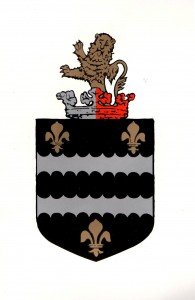
In about 1628, John Gorsuch married Ann Lovelace, daughter of Sir William and Anne Lovelace and sister to John’s friend, Richard Lovelace, a Cavalier poet famous for the lines:
Stone walls do not a prison make
Nor iron bars a cage
and
I could not love thee dear so much
Loved I not honour more.
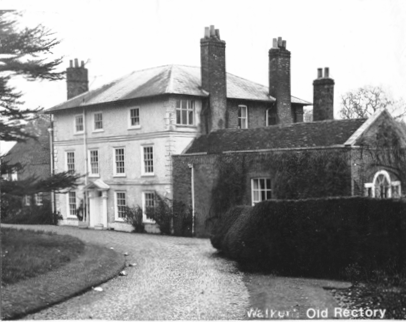
John and Ann initially set up home in London and three children were soon born to them. This was a time of change and the patronage of church livings (advowsons) were being bought by individuals and corporations. Soon after his son’s marriage and having invested in property in Hertfordshire, Daniel Gorsuch bought the advowson of St. Mary’s, Walkern.
When Daniel bought the living the old parsonage house was at Clay End, a good distance from St Mary’s, so he built a new rectory, close to the church.
The rectory was one of the earliest all-brick houses built in England and had glazed sash windows in oak frames. It is basically still the same, square in outline, with brick walls, three floors and a ‘hipped’ tile roof sloping on all four sides. The only difference is in the front facade which was changed sometime in the late 1700s, and a “long” room added on the south side (this was built to house the library of Benjamin Heath, the rector of Walkern 1781-1817). The front entrance could conceivably have faced the church on the east side with a path and bridge over the river Beane to the churchyard.
Four years after their marriage John was instituted as Rector at Walkern, the mandate signed and sealed on behalf of King Charles, and he and Ann had moved with their growing family to the newly built rectory.
The clash of views
It was during this period that the Gorsuch family repaired and improved St Mary’s, building a monument into the south wall of the chancel and installing a plain square East window (a window that was lost at the time of a major renovation in the 1870s). It was also during this time that John had the altar, or communion table, set behind altar rails under the new East window. This was a controversial move.
Altar rails for communion had been introduced by the Archbishop of Canterbury, William Laud as a religious and political statement – he believed in ritual and the divine right of kings, and was opposed to religious toleration. John Gorsuch was a follower.
The first incident occurred at Christmas 1636. Thomas Humberstone of Walkern Park and his wife, with Puritan leanings, refused to come up to the altar rails for communion. They knelt at the chancel steps but John Gorsuch refused to give them the sacrament.
Again at Easter the same couple raised their objections to approaching the altar rails and being denied the sacrament they referred the matter to the Archdeacon who after interviewing Gorsuch wrote them a “persuasive letter to reform their carriage”.
So they petitioned John Williams, Bishop of Lincoln. He was sympathetic to the Puritan faction and ordered Gorsuch to administer the communion “to all who presented themselves kneeling in any part of the church under pain of suspension” and with the threat to depose Gorsuch’s curate, Francis Beckwith.
Gorsuch appealed. John Williams had by this time been imprisoned in the Tower for malpractices in State Affairs, and Archbishop Laud had taken charge of Lincoln Bishopric, so the rector was supported. On 28th October a bond was filed against Thomas Humberstone “… to exhibite a true and full certificate of his due frequenting of his parishe church of Walkerne and divine service
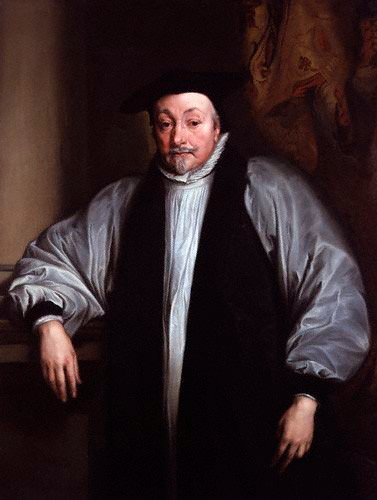
Archbishop of Canterbury William Laud, after Sir Anthony Van Dyck,
painting (circa 1636)
The Humberstone couple conceded and no further steps were taken against them either by John Gorsuch or his curate Francis Beckwith.
The death of Daniel Gorsuch
In the meantime John’s father had died. Daniel’s burial is recorded in the Walkern Parish register on 8th October 1638, signed by John Gorsuch, Rector.
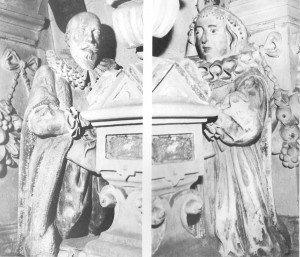
The Gorsuch memorial in St Mary’s reads: “Daniel Gorsuch, Citizen and Mercer of London in the month of July 1638, caused this Tomb to be made for himself and his wife Alice by whom he had three children, John, Katherine and Joanna, his age being 69 years 6 months and odd dayes. And he died on the 8th day of October, 1638”.
In Daniel’s will, made at Walkern two days earlier, he left property in London to his wife and to John Gorsuch, a sum of £500 to his daughter Katherine, property in Weston to his grandchildren Daniel, John, William, Katherine, Robert and Richard, and a variety of smaller legacies to other friends and relations.
During the years 1641-1642 the Universities were released by Parliament from an injunction “requiring them to do reverence to the Communion table”. They were to remove the altar and the surrounding rails from the east end of all chapels, and level chancels.
In 1642 John Gorsuch was ejected from the parish of Walkern by Parliament and had his living removed. He was accused of endeavouring “to hire one Jones to ride a Troop Horse for Prince Rupert (a nephew of Charles I) … and had published a wicked libel against the Parliament that some of the Lords whom he named were Fools, Bastards and Cuckolds”.
John White, in his “First Century of Scandalous Malignant Priests” published in 1643, wrote that the benefice of John Gorsuch,
“Doctor of Divinity, Rector of the Parish Church of Walkerne in the County of Hertford, is sequestered for that he is a common haunter of Ale-houses and Taverns, and often drunke; and oft sitteth gaming whole nights together, and is seldom in the Pulpit, preaching scarce once a quarter; and hath often denied many of his Parishioners the Sacraments of the Lord’s Supper, without any cause shown, and refused to administer it to such as would not come up to the rails …”
The Rev. Nathaniel Ward, was installed in place of Gorsuch, and had to allow £20 a year, namely a fifth part of the stipend, to Mrs Gorsuch, for the maintenance of herself and her children. Walkern appears to have been on the side of Parliament and in 1643 whilst Ward was Rector the Covenant was signed in Walkern Church.
Nathaniel Ward died and was succeeded by Simon Smeath, Vicar of Weston, a staunch Parliament man, who was attracted to the Rectory in Walkern with the expectation of two livings.
The fact that John Gorsuch owned the parsonage must have caused problems for Smeath. It was not difficult to imagine that Gorsuch moved his family to nearby Weston where his mother was still living, but he might conceivably have remained in residence in Walkern, claiming tithes from the surrounding glebe land which was by rights his property.
The note affirming that in 1647 Simon Smeath persuaded Fairclough of Weston to send a body of rebels to seize and eject Gorsuch who was still around and “causing a nuisance”. It had become a personal involvement between neighbouring clergymen with opposing religious political views.
A copy of Henry Chauncey’s “Antiques” was found with a marginal note made some 100 years later by Thomas Tipping, Vicar of “Yardley” (now Ardeley). “Dr. Gorsuch,” he wrote, “was smothered in an haymow”. This is the only statement on record made about John Gorsuch’s fateful end. Thomas Tipping concluded; “He left a very good name”.
An entry under “Burials” in the Parish Register of Wilburton Church in Cambridgeshire, for 1648, reads: “Doctour Godsuch, Dr of Theologie, May the 24th”. There seems to be no other record which ties up with Dr. John Gorsuch.
It is strange that he should have been buried so far from Walkern. The village of Wilburton is north of Cambridge and half way to Ely, the home of Cromwell and his faction. Was John Gorsuch being taken there to be imprisoned at Ely House by Cromwell’s militia? Or had he been imprisoned and was trying to find his way back to Walkern? We shall never know.
Anne Gorsuch left for America with four children, Robert, Richard, Anne and Katherine about 1651. She could have taken her children to Virginia where the Lovelace family were already settled. She seems not to have survived long as letters of administration of her estate, dated 2 June 1652, were issued to Daniel her eldest son in England as she had “deceased in parts beyond the seas”.
Katherine married, but returned to England, three years later, widowed with two young children. Brother Robert returned too, though much later. They must have rejoined their other brothers Daniel, John and William at Weston. Their grandmother, Alice Gorsuch (nee Hall) died in 1662 and Daniel was the executor of her will.
It only remains to say that the Rev. Simon Smeath was deprived of the living in 1660 at the time of the Restoration, when Charles II came to the throne.