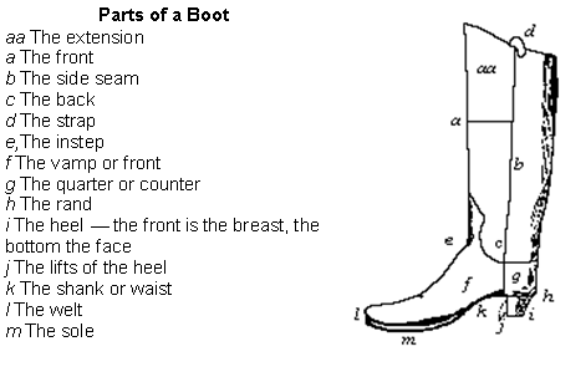
Article taken from Encyclopedia Britannica, 11th ed. (1910) v. XXIV pp. 992-994
Firstly the sole is cut out and assembled: consisting of a pair of inner soles of soft leather, a pair of outer soles of firmer texture, a pair of welts (bands about 1 in. broad) of flexible leather, and lifts and top-pieces for the heels. These are steeped in water to make them flexible. The insoles are attached to the bottom of a pair of wooden lasts (blocks which are the form and size of the boots to be made), the leather is fastened down with lasting tacks and when it is dried, is drawn out with pincers till it takes the exact form of the last.
Then the bootmaker “rounds the soles,” by paring down the edges close to the last, and forms a small channel or feather round these edges, cut about one-eighth of an inch in the leather. Next the insoles are pierced all round with a bent awl, which bites into but not through the leather, and comes out at the channel or feather.
The uppers are then placed the on the lasts, drawing their edges tightly round the edge of the insoles, and fastened in position with lasting tacks. “Lasting” is a crucial operation, for, unless the upper is drawn smoothly and equally over the last, leaving neither crease nor wrinkle, the form of the boot will be bad.
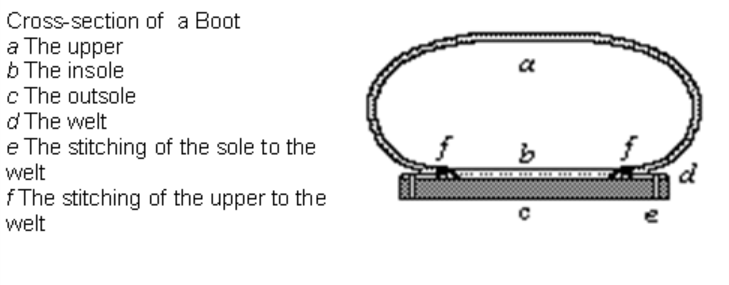
The welt, having one edge pared or chamfered, is put in position round the sides, up to the heel and the maker proceeds to “inseam” by passing an awl through the holes already made in the insole, catching with it the edge of the upper and the thin edge of the welt, and sewing all three together in one flat seam, with a waxed thread. He then pares off inequalities and “levels the bottoms,” by filling up the depressed part in the centre with a piece of tarred felt; and, that done, the boots are ready for the outsoles.
After the leather for the outsoles has been thoroughly compressed by hammering on the “lap-stone” they are fastened through the insole with steel tacks, their sides are pared, and a narrow channel is cut round their edges; and through this channel they are stitched to the welt, about twelve stitches of strong waxed thread being made to the inch.
The soles are then hammered into shape; the heel lifts are put on and attached with wooden pegs then sewed through the stitches of the insole; and the top-pieces, similar to the outsoles, are put on and nailed down to the lifts. The finishing operations embrace pinning up the edge of the heel, paring, rasping, scraping, smoothing, blacking and burnishing the edges of soles and heels, scraping, sandpapering and burnishing the soles, withdrawing the lasts, and cleaning out any pegs which may have pierced through the inner sole. Of course, there are numerous minor operations connected with forwarding and finishing in various materials, such as punching lace-holes, inserting eyelets, applying heel and toe irons, hob-nailing, &c. To make a pair of common stout lacing boots occupies an expert workman from fourteen to eighteen hours.