Walkerns Magna Carta Baron
A recess in St Mary’s church in Walkern houses this remarkably fine Purbeck marble effigy of a knight with crossed legs, in a suit of chain armour with shield, sword and closed flat-topped helm. It is one of only three known instances in England [see comment below] in which the visor is drawn down the face. The monument dates from the 13th century.
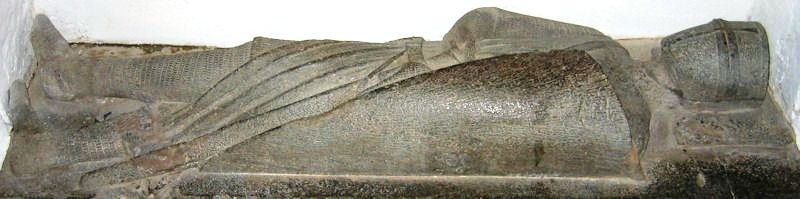
The effigy is thought to represent William (III) de Lanvalei (c.1182-c.1217) lord of Walkern and one of the twenty-five Magna Carta sureties appointed by the rebal barons at Runnymede in 1215 to ensure that King John adhered to the Law of the Land set down in the charter. William had inherited the manor of Walkern, along with several other properties, through his father (William II) and his grandfather (William I) de Lanvalei who was a member of Henry II’s Household and one of the king’s Justices. William I acquired the Barony of Walkern, which included lands in several counties, plus custodianship of Colchester Castle, through marrying the king’s ward Gunnor de St Clair.
Although the de Lanvalei barons probably didn’t live in Walkern, it was important as the administrative centre (‘caput honouris’) of the barony, and its centre of gravity.
When William III died in 1217 his daughter and heir, Hawise, was made the ward of the king’s Justice Hubert de Burgh. About 12 years later Hubert’s son John de Burgh married Hawise, and John held Walkern in her right.
It was not unusual for great baronial families to commission effigies of significant members of their family. It was a very public, and expensive, way to mark the status and wealth of a family, and it has been postulated that Hawise and her husband commissioned the effigy to honour her father William III de Lanvalei, the last male of the line holding the barony of Walkern, and a surety of Magna Carta.
The Walkern Effigy
Although there are about 100 Purbeck marble effigies in England, only three have a great helm with its visor closed, and none are as well preserved as the Walkern knight. The style, workmanship and choice of Purbeck marble support the idea that the effigy was made in the same workshop, near the present St Paul’s Cathedral, as the figures in Temple Church in London.
For many years it was thought that crossed legs on an effigy were a sign that these knights were crusaders, but this view has long been discredited. The important crusading era had ended by 1250 yet the cross-legged tradition continued for another hundred years. It is now thought that the crossed legs are actually a stylistic convention used by contemporary artists, together with the position of the hand on the sword, to introduce a liveliness that was quite distinct from those effigies where the knight was in ‘prayerful’ sleep.
There is a tradition that the effigy was brought to Walkern from Temple Dinsley, or Baldock, or from the nearby manor of Box. The only shred of evidence for this is that the figure’s base does not fit the recess. A simpler explanation is that it had always been at Walkern and originally stood on the floor of the chancel, as do the effigies in the Temple Church. Subsequently, when the chancel of Walkern church was rebuilt, the effigy was moved into the recess in the south wall.
More information can be found in Mediaeval Walkern & Magna Carta (2013) by Peter Sinclair, published by Walkern History Society.