Written by Janet Woodall in April 2021 for the Walkern Journal
In its heyday before WWII, Kitchener’s in Walkern would be able to supply you with almost anything you wanted. An article in the Walkern Journal in 1975 recalled hob-nailed boots, corduroy trousers (for farm work), material sold by the yard, straw boaters, binding string and oil lamps. The shop windows displayed maid’s uniforms and biscuits, and offered sugar at l½ d per pound (lump sugar 2d). The premises also boasted a bakery and its own pig slaughterhouse, with bacon being cured in the basement. There was a ‘branch’ a few houses down the street at the Red Lion (now called Redlyn) which was known as the Tin Shop as it sold hardware – metal baths, buckets and the like. A ‘branch’ opposite the main store sold chinaware; and a ‘branch’ at Pearman’s bakery opposite Totts Lane sold sweets, fancy goods and toys.
How did this shopping empire arise? Well, the story begins in the early 1800s with a footman called William Holliday.
Born in Northants in 1786, Holliday came to Walkern as footman to the Revd Dr Benjamin Heath, the Rector of St Mary’s from 1781 to 1817. Surprisingly, as someone working in a prime position in the Rector’s household, William was not C of E but was a nonconformist. The Rector’s niece (who was rather charmingly named Angel Heath) recalled William in later years as “the Baptist footman whom my Uncle christened because he could not otherwise conscientiously bury him if he should die in his service”.
William married a village girl and fellow nonconformist, Ann Ball in 1810. At that time marriage could only take place in a C of E church, and as the couple would not attend church to hear the Banns they had to obtain a special license. The following year Ann was received into Walkern’s Independent church (now the URC chapel) when it opened for worship for the first time. William also joined the Independent church in 1814, becoming its deacon until 1821. William later became a Baptist, attending the chapel newly built in Froghall lane. Angel Heath remarked in 1840 that William had “gone back to his Baptist ways”.
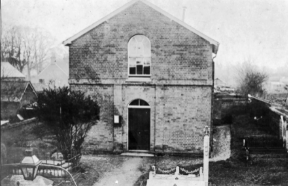
Froghall Lane
It is likely that William left the Rector’s employment when he joined the Independent church, and by 1816 he had set up as the village “carrier” transporting letters, packages and passengers to surrounding villages and towns. He continued being the village carrier until he retired.
In 1817 William bought the house that would eventually become Kitchener stores, but he initially leased it out to another villager, Mrs Titmuss. During this period he and his young family rented the house opposite, now known as Three Limes at the corner of Winters Lane next to the White Lion. This property was sold in 1832 and the sale notice states that it was a general store with Mr Holliday in occupation, so he was now the village carrier and a grocer.
Sadly, by then his wife Ann had died, as had three of their children. William and his five surviving children moved across the road to set up shop in the building he owned, and thus began the retail empire. Two of his daughters, Susan and Emma, helped their father in the shop, and were to become the next links in the dynastic chain.
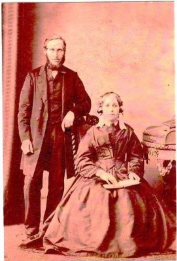
Susan Holliday
n 1845 Susan married William Bray, though she continued to work for her father. The Brays were a long-established family of wheelwrights in Walkern, plying their trade from premises opposite the Yew Tree. In the mid-1850s William Bray bought the grocery shop from his elderly father-in-Law, and it appears that Susan ran the shop alongside her father. It was now described as a grocers & drapers.
William Holliday died in 1862 aged 76 and is buried at the Baptist chapel. William and Susan Bray then sold the business to follow their calling as Baptist preachers, eventually settling in Hitchin. They sold the shop to their brother-in-Law, John Elliot Kitchener who had married Susan’s sister, Emma Holliday.
John Eliot Kitchener had been born in Stevenage but served an apprenticeship with Daniel Pearman in the bakery opposite Totts lane. By the time he and Emma married in 1856, he was a master baker, and it seems likely that it was John who built the bakery in Kitchener stores. Emma was a dressmaker and at one point was a straw bonnet maker, sewing the hats from straw plait purchased from other villagers. John was a well-respected figure, serving a stint as a village constable, as an overseer of the poor, and as chair of the village Vestry committee (a forerunner of the parish council).
They had six children who assisted in the shop at various times, but it was their son Ebenezer who would inherit the business. John retired in the early 1880s and moved in with son number two (also named John Elliot Kitchener), and they established a bakery in the expanding area south of Froghall lane. Coincidentally, in 1882 they bought the house now occupied by my mother at the south of the village (160 High St).
John snr died in 1892 and his wife Emma in 1899. Like Emma’s father, William Holliday, they are both buried in the Baptist chapel grounds in Froghall lane.
Ebenezer had taken over the main business when his father retired, expanding it and naming it Kitchener Stores. By 1886 he was described in trade directories as a “grocer & tea dealer, draper, boot, shoe dealer & ironmonger”.
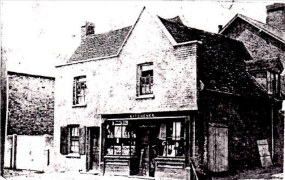
in late 19th century
(photo courtesy of Yvonne Emerton)
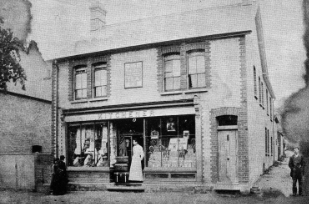
You may also be interested in Kitchener Stores by Mrs Clark