This was written by Anthony Camp MBE, FSG in July 2009 and published in the October 2009 issue of the Walkern Journal
The two photographs of Walkern blacksmiths reproduced in the July-August Walkern Journal have prompted me to look through my notes about Walkern families to see what can be said about blacksmiths in the village in the more distant past. With a population of less than 850 prior to 1900, Walkern seems not to have supported more than one smithy at any one time.
The first named blacksmith that I have found was Edward Wenham the Elder who was born at Walkern in 1604 (when the surname was usually spelled Wennam) and was described as a blacksmith when his son married at Ardley in 1655 and in his will made early in 1661. He was buried at St Mary’s in July 1661. His eldest son Edward, who died in 1671, was also a blacksmith and the father of George Wenham who was apprenticed to a gun-maker in London in 1682. The younger Edward’s brother Henry, whose trade is not known, was the father-in-law of Jane Wenham the ‘Witch of Walkern’.
In the eighteenth century blacksmiths were generally prosperous people and their social status was among the upper ranks of skilled craftsmen.
Sometime before 1707 William Rotherham or Ratherum, a blacksmith, came into Walkern with his wife Elizabeth. He was buried at St Mary’s in 1739. His son Philip, also a blacksmith, died in 1741. In 1722 William had been described as a servant to John Crouch of Weston, maltster, whose malting house at Walkern together with 30 quarters of malt had been destroyed by fire.
Robert Bennett who had married Sarah Grubb at Ardley in 1724, came to the parish as a blacksmith and farrier the following year. Farriers were less frequent than blacksmiths and specialised in shoeing and treating horses, while blacksmiths carried out general forged metal work as well as shoeing. Robert seems to have worked with his sons John, born in 1725, and William, born in 1733. In 1763 Michael Welch, from All Saints, Hertford, came to help them and in 1769 he married Robert’s youngest daughter Susan, but died soon afterwards. Robert Bennett himself died in 1774 leaving a will in which he left all his stock and tools to his son John who continued the business until he died in 1777. John Bennett had no surviving sons, and although many Walkern families descend from his daughters (who married John Cox, Thomas Bray and William Ball) he seems to have been the last of the Bennett family to work in the village as a blacksmith.
Between 1758 and 1785 the lists of those liable for service in the Militia show, for very short periods, a number of men described as blacksmiths (William Peters and Kester Godfrey in 1765, William Izard in 1768 and William English in 1780) but the place of the Bennett family seems to have been taken by Underwood Dearman who had come from Weston to marry Sarah Warren at Walkern in 1755.
Underwood Dearman died in 1809, again bequeathing to his son William “all the utensils and stock in trade” in his blacksmith’s shop. His personal estate was valued at £20 but he died owing £10 on the purchase price of his house and land.
Towards the end of the eighteenth century the social status of blacksmiths had deteriorated. William Dearman, who seems to have been Underwood’s only surviving son by a second marriage, and whose wife Sarah was also a Dearman, made no fortune from smithing and died in the Union Workhouse at Hertford in 1843, aged 64. Their son, also called Underwood Dearman and another blacksmith, died in the workhouse, aged 39, just ten years later.
A second William Dearman, baptised at Walkern in 1799 (the son of John Dearman another Weston man), who had married Ann Hills at Walkern in 1815, was described as a blacksmith at Walkern in 1816 but became a labourer and moved to Bayford in the 1830s.
For some years in the early nineteenth century William Ansell was a blacksmith in Woodcock Alley, Walkern. He was born at Little Munden about 1791, but had become a blacksmith at Walkern by 1828. He was buried at St Mary’s in January 1861. He does not appear in the Walkern trade directories and it may be that he was working for William Dearman whose name is in directories for 1845 and 1851 though he is not listed in the Walkern census for 1851.
The name of Charles Cock, who was born at Walkern in 1808, appears in the 1841 census and later directories as a blacksmith but in 1851 he described himself as a whitesmith [someone who works in tin]. Sometime after 1869 he moved to Stevenage but he was buried at Walkern in 1886.
The directories meanwhile show two members of the Newberry family as blacksmiths, George in 1874, and William in 1882. William had been born at Holwell in Bedfordshire about 1842, but in 1891 said that he was a retired blacksmith and was now a publican and parish clerk. The latter post he held for some years.
Frederick Dearman, probably related to the family mentioned above, who was born at Weston about 1832 and had worked as a labourer for Joseph Beaumont at Lannock Farm, Weston, had a blacksmith’s shop near the Robin Hood at Walkern by 1861, and appears regularly in later directories. He died in 1909, aged 76. His two sons, William and Walter, originally worked with him. The youngest, named Walter Oliver Pearman (after his mother, Ann Oliver) became a coal merchant.
The eldest son, William Dearman, born in 1865, gave his occupation in 1894 (when he married) and in 1898 as ‘shoeing, machinist and general smith’. By 1902 he was an ‘agricultural implement agent and machinist’. He died at The Willows, Stevenage Lane, on 29 January 1915, aged 49, and was buried at St Mary’s. His widow, formerly Florence Edith Aldridge, died there on 3 December 1941, aged 71.raph
The place of William Dearman as a blacksmith seems to have been taken by William John Green who appears in directories at Walkern in 1912 and 1914, and whose photograph outside his house on the corner of the High Street and Totts Lane appears in your July-August issue. The board over the door proclaims him as ‘Shoeing & Jobbing Smith”. He does not seem to have been a Walkern man (or connected with Walter Green the well-known undertaker) and had left the parish by 1926. He was not buried at Walkern.
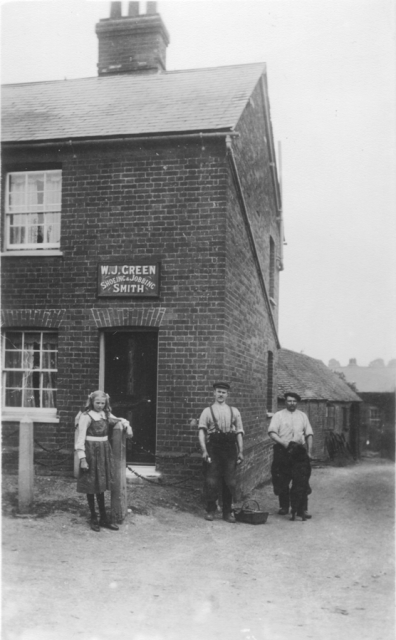
61 High Street
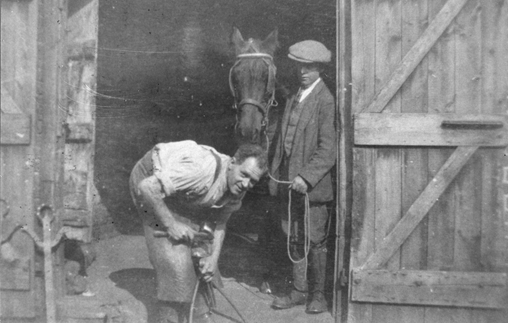
The second photograph is that of Sidney Robinson the last blacksmith at Walkern who came, it seems, from West Ham to take Mr Green’s place, in 1917. He was certainly a blacksmith at The Forge, 61 High Street, Walkern, from at least 1926. He died at Lister Hospital on 28 January 1962, aged 78. His widow, formerly Florence Sarah Ann Hodgson, continued to live at that address and died on 4 July 1972, aged 88. Both are buried at the Independent Chapel. Their only child, Edith Kate, who had been born in West Ham, died when only four days old, and was buried at Walkern in 1917.
With the advent of Terry Pitman it is good to know that this old trade will flourish in the village again.
A note from Marjorie Ashurst on Sidney Robinson, the Walkern Blacksmith
A few clarifications of the excellent article written by Anthony Camp in last month’s WJ. Sidney Robinson didn’t come from West Ham, the family came from Cambridgeshire, the villages of Willingham and Over, arriving in Walkern in the early 1920s – we came to live next door to them, at the bicycle shop, in 1925. He was buried in the Congregational Church (now URC), which was run in conjunction with the Wesleyan Chapel in Totts Lane—he was a pillar of the Wesleyan church, and was part of the structure of running it. He was a quiet and friendly man, and a highly respected craftsman, and certainly not a “jobbing blacksmith” – the board outside his shop had some sort of diploma on it. His wife was a small and busy woman, well known as a wonderful cook, dressmaker and gardener and one time secretary of the WI. They had a daughter called Vida.
Letter to the editor from Les Swain
In reply to the query in the July-August WJ about Walkern farriers and blacksmiths
Living at Church End from 1922 to 1934 I passed Mr Robinson, the blacksmith at the corner of Totts Lane on my way to school and on the way home, there were no school meals in those days so I passed him four times a day. He was a very kindly man who had no objection to us children who would watch him making the horse’s shoes and other bits and pieces for agricultural implements, not to mention the shoeing of the horses. He would handle the heaviest of them, picking up their large often very dirty feet and he would be clouded in acrid smoke when fitting the hot shoe to the horse.
He was a heavy smoker as were most men and there would always be a twenty packet of Players in the nail box just by the side of the little window looking out onto Totts Lane. Cigarette cards were included in the packets and they would just be thrown into the nail box for the first child to see and pick up.
There was a small coke fire with a long handle operating the bellows, two or three pumps and the cokes would be white hot. The metal heated he would hold it in his tongs onto the anvil and hammer it into shape having to reheat it many times especially the shoes. Horse shoes that were quite an intricate shape with about ten or a dozen holes and a lip turned up at the front – all different sizes of course. I remember vividly a hot piece of scale or metal once landed on my shoe right in the lace hole!
At the time I am relating to there were six farms in and around the village. Richard Foster and his Mother at Rooks Nest, Cecil Riche and family at Finches Farm, Mr. Banks at Manor farm, the Cordells at Bridgefoot Farm in Church End (where I would help out harvest time, and sometimes stone picking), the Shepherds and Dick Foster at Bassets Green, and Walkern Hall although that was really closer to Bennington. All of them would have five or six shire horses as well as the riding horses. Mr Robinson was a very busy man. I believe it was about 1934 when the tractor was first introduced by the Shepherds, always the innovative family in farming around here. From then on the work for a farrier diminished I suppose.